Explore our summer centres
Contact us

Follow us:


.svg)
.webp)


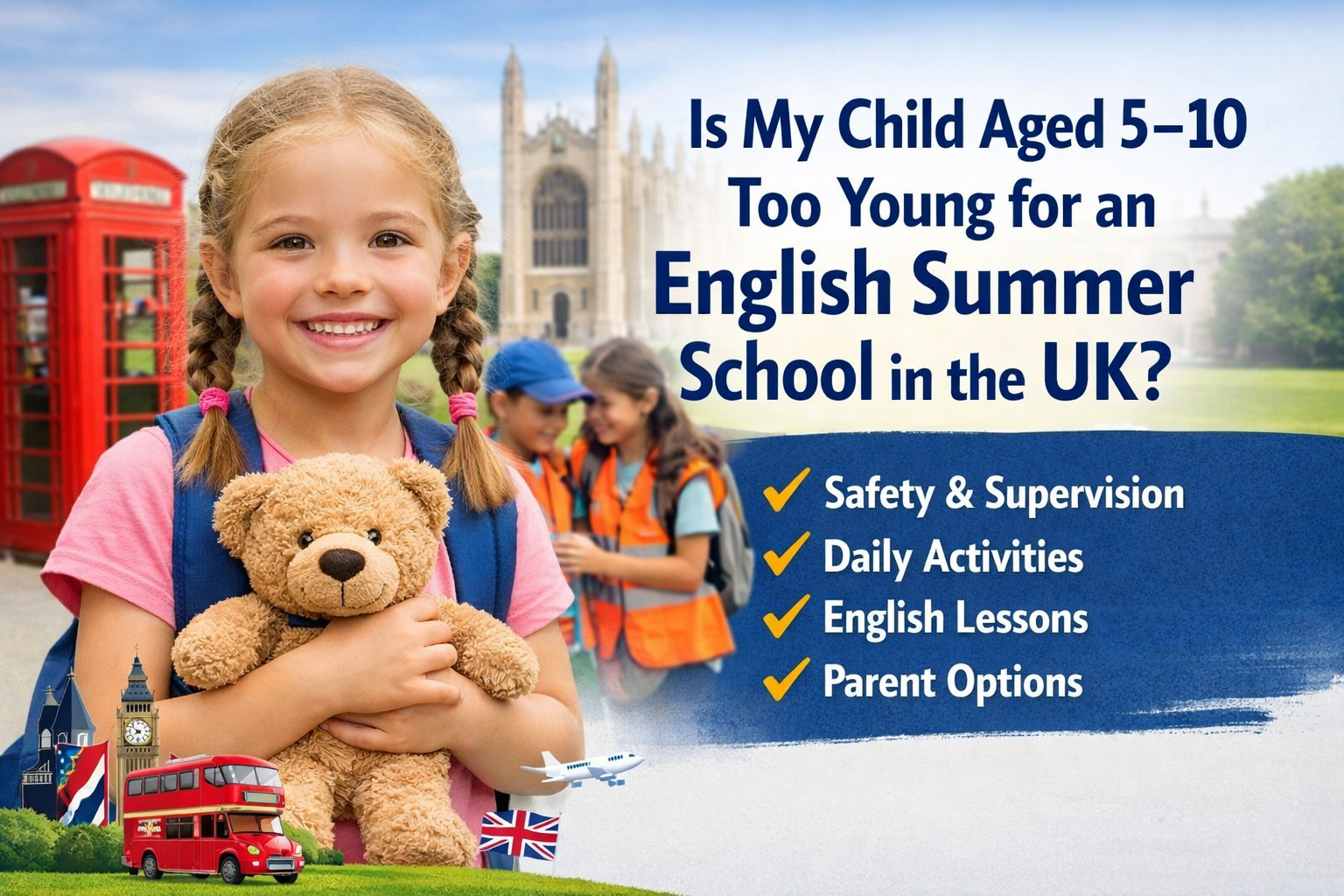
For many parents, the first question is not about price or location — it’s this:
“Is my child too young to attend an English summer school abroad?”
If your child is aged 5, 6, 7, 8, 9 or 10, the answer is:
👉 Not if the programme is designed specifically for young learners.
Modern English summer schools in the UK now offer specialist programmes for younger children, with age-appropriate teaching, close supervision, and flexible options for families — including the possibility for parents to travel and stay nearby if they wish.
This guide explains how young learner summer programmes work, what makes them safe, and how to decide if it’s right for your child.
Programmes for younger children are very different from teen summer schools. A proper 5–10 programme includes:
Lessons are built around communication and confidence, not exams or heavy grammar study.
A young learner English summer school day usually combines lessons and activities.
Example structure:
Morning
Afternoon
Children continue using English naturally throughout the day — not only in class.
Safety is the number one priority in reputable UK young learner programmes.
Strong programmes provide:
Parents should always choose a programme that clearly explains its safeguarding and supervision standards.
No. Children aged 5–10 can join as:
Students are grouped by age and level, so they learn with similar classmates.
At this age, children learn quickly through immersion and interaction.
This is very common — and expected.
Young learner teachers are trained to support:
Activities are designed to build confidence step-by-step. Most children settle quickly once they are engaged in games and group tasks.
Not necessarily.
For 5–10 programmes, there is usually flexibility:
✅ Children can attend independently within the supervised programme structure
✅ Parents are welcome to travel and stay nearby if they prefer
✅ Some families choose to make it a combined learning holiday
✅ Others allow children to attend the day programme while staying locally
This flexibility is one reason younger age programmes are growing in popularity.
Cities like Bristol and Cambridge are ideal for children because they offer:
These environments support both learning and wellbeing.
Most young learners join for:
Even one week can significantly improve confidence and listening skills.
Your child may be ready if they:
Perfect English is not required — curiosity is.
A well-designed English summer school for ages 5–10 is not just about language learning. It builds:
With the right structure and supervision, it can be a safe and positive first international learning experience — with or without parents travelling alongside.
Tip: Always review programme details, supervision policies, and daily schedules before booking — and choose a course built specifically for young learners, not adapted from teen programmes.
Copyright © 2025 by ILC. All Rights Reserved.


.webp)